top of page

Magni Research
Six weeks to failure
Progressive Recrystallization and Loss of Cement (OPC + silica fume) Integrity at 425 °C and 14.5 ksi
Starting Material
Ordinary Portland Cement + 30% Silica fume (by mass)
Cured at room temperatures for 72h

Scanning electron microscope image of: medium grey calcium-silicate-hydrate matrix, white angular pieces of clinker materials (e.g., belite) and darker grey, homogeneous zones of silica fume.
Image is taken along a fracture plane following a Brazil Test.
Two-weeks at 425°C, 14.5ksi
The cured ordinary Portland Cement + 30% Silica fume (by mass) was place in a gold capsule with 18 wt% fluid (designed to match produced waters from the UT Forge site). The core was heated to 425°C at a rate of 1.6°C/min. The core was ramped down at 1°C/min. Pressure was held constant at 14.5 ksi during heating and cooling. After the experiments, the core retains its cylindrical shape. The core broke during extraction from the capsule.


Heterogeneities from the starting material (e.g., silica fume, belite) are mostly homogenized; some regions of Ca-rich material and silica fume persist. The major change is that recrystallization has started to occur, where the C-S-H matrix is being transformed into wollastonite due to fluid interaction. The recrystallization is associated with a volume change and an increase in porosity.
Four-weeks at 425°C, 14.5ksi
The core (now aged for two-weeks) was place back in a gold capsule with a fresh aliquot of fluid (again by 18% mass) and returned to temperature using the same heating and cooling ramps and held for another two week interval.


After four-weeks, the core shows obvious signs of deformation at the macroscopic scale (e.g., buckling). SEM imaging of the core reveals anastomosing recrystallization pathways associated with fracture development (i.e., textural changes are associated with fractures).
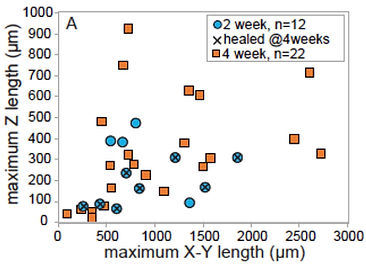
Fracture lengths and fates obtained from µXRCT images of the core reveal that fractures form and heal in generations. The two week fractures (n=12; max length= 1873µm; max aperture= 60µm) were healed in the four week experiments and a new generation of longer fractures had formed (n=22; max length= 2730µm; max aperture= 69µm).
Six-weeks at 425°C, 14.5ksi
The core (now aged for four-weeks) was place back in a gold capsule with a fresh aliquot of fluid (again by 18% mass) and returned to temperature using the same heating and cooling ramps and held for another two week interval, for a total reaction time of six weeks.


After six-weeks, the core lost its integrity and collapsed (it was disaggregated upon opening the capsule). SEM images reveal the continued crystallization of wollastonite, where crystals became wider/coarser through the experiment (not necessarily longer). The average crystal widths in the two-week experiments were 1-4µm; in the six-week experiments, average crystal widths increased to 4-12µm. Coarsening of wollastonite is associated with fracture formation. Irregular fracture patterns follow textural changes.
SEM images show faceted crystals of wollastonite growing from the C-S-H matrix into void space adjacent to the cement core (below).

Evolution of the fluid
We analyzed the fluids in equilibrium with the cores to understand the mass balances in the system. Fluids were harvested by puncturing a capsule in known mass of dilute nitric acid, which was analyzed via ICP-OES.
Ca and Si contents increase in fluids (recall fluids were replenished after every two week interval). The increase in Ca and Si in the fluids are consistent with the increased surface area in the core due to formation of fractures during recrystallization of the C-S-H matrix.

Conclusion:
The loss of integrity is due to localized (i.e., spatially heterogeneous), progressive recrystallization of the C-S-H cement matrix into wollastonite and coarsening of the wollastonite crystals through time. The coarsening creates fractures and thus structural weaknesses in the cement through time, which lead to the failure of the core in the six-week experiments. Based on this experimental series, we suggest that the general process of coarsening may lead to failure.
bottom of page